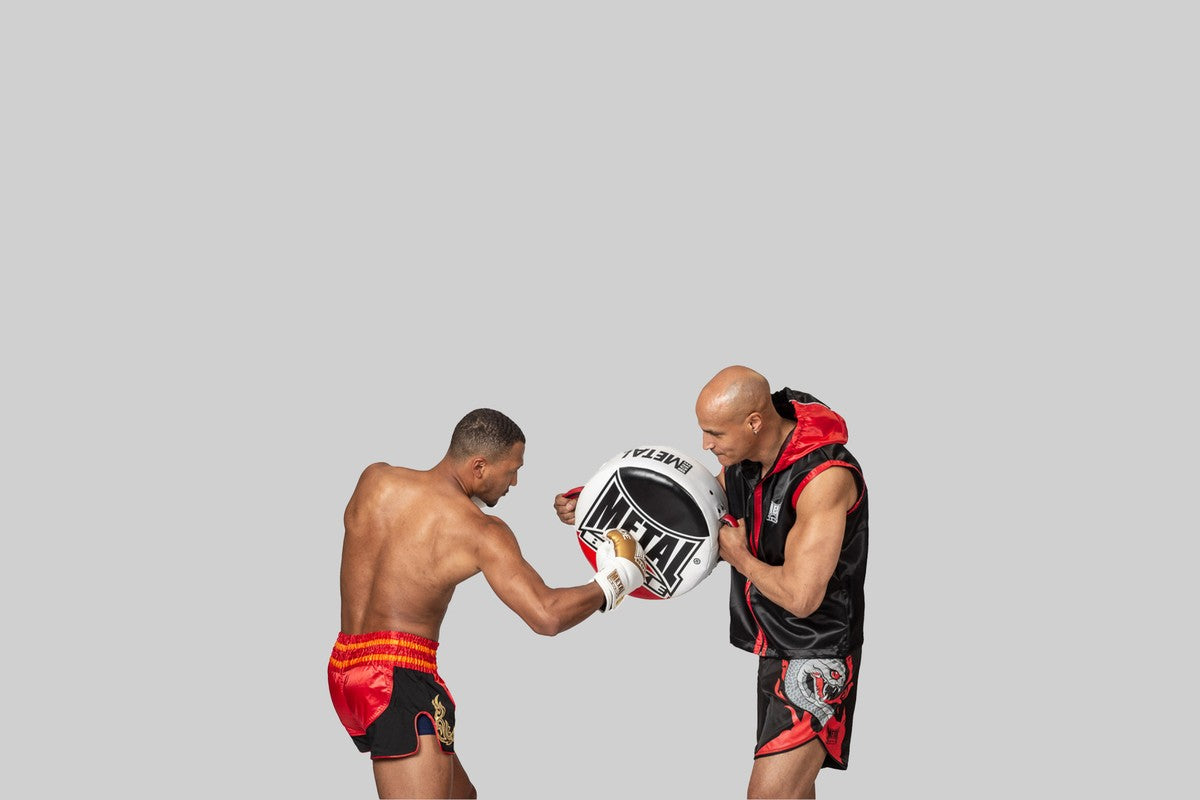

Different types of boxing: the guide to choosing your discipline
A pair of gloves, two fists, a ring. Then shins, knees, elbows, and sometimes throws to the ground. The term "boxing" covers a wide range of very different combat sports, each with its own weapons, rules, and history. Choosing the right one starts with understanding what sets them apart. This guide explores the different types of boxing, from boxing and MMA to savate and muay thai, detailing the techniques, benefits, and ideal profile for each. Find the discipline that's right for you, whether your goal is cardio, self-defense, or competition.
What sets the different types of boxing apart
A single criterion separates most types of boxing: the permitted strikes. Boxing only allows punches. Savate adds kicks. Muay thai also permits knee and elbow strikes. MMA combines striking and grappling. Other differences include the surface (ring, mat, or cage), the level of contact (light, semi-contact, or full contact), and the rules specific to each discipline.
In other words, there is no single form of boxing, but rather a range of fighting styles, from highly structured to comprehensive. Some emphasize punching technique and footwork, others a variety of strikes, and still others close-quarters combat. They all share the same foundation: a guard, footwork, bag work, and a high level of physical fitness. This common foundation makes moving from one form of boxing to another easier than you might think. Yet each discipline has its own advantages: one offers more movement and footwork, while the other provides greater arm power, which explains the variety of styles and the different sensations you'll experience with each.
Boxing, the noble art of the fists
Boxing is the best-known pugilistic discipline. It is known as the noble art, having originated in England, where it was codified in the 19th century. Its rules are straightforward: only punches above the belt are allowed, delivered to a mobile opponent in a ring during three-minute rounds. Four fundamental punches form the basis of boxing: the jab, the straight right (the cross), the hook, and the uppercut. Its richness lies in combinations, timing, and footwork, not in the number of techniques.
It is a sport of speed and precision, where evading a punch is as important as throwing one. It has produced legendary champions, from Muhammad Ali to Mike Tyson, and remains the natural entry point into combat sports: the techniques are limited, but they take years to master. To get started, a pair of boxing gloves and hand wraps are all you need. We explain each technique in our beginner's guide to bag exercises.


French boxing or savate, the French style of kickboxing
Savate, or French boxing, is the major French kickboxing discipline, originating in 19th-century France from Parisian savate, which Charles Lecour combined with the punching techniques of boxing. Its signature: kicks are delivered with shod feet, never with bare shins. The kicks are precise, almost fencing-like, and have codified names such as the whip kick, the chasse, and the reverse kick.
It is an elegant, technical form of boxing that rewards reach, balance, and flexibility more than raw power. It can be practiced as assault (controlled contact) or combat (full power), making it accessible to both beginners and competitors. For those seeking a comprehensive discipline that combines cardio and gymnastics, savate ticks many boxes without the sometimes brutal power struggle of muay thai.
Thai boxing or muay thai, the art of eight limbs
Nicknamed the art of eight limbs, Thai boxing (muay thai) uses eight striking surfaces: two fists, two feet, two knees, and two elbows. It is one of the most comprehensive and intense forms of boxing, featuring close-quarters combat, clinching, and low kicks—low kicks aimed at the opponent's thighs.
The national sport of Thailand, muay thai is also an excellent way to develop power, endurance, and mental toughness. It requires more specialized equipment than boxing: muay thai gloves designed for clinching, shin guards, and a mouthguard. Its similarity to kickboxing makes it a natural stepping stone to MMA.

Kickboxing and full contact, the art of kicking and punching
Kickboxing encompasses several styles of kickboxing that emerged in the 20th century, often described as a combination of boxing and kicking. Punches are thrown like in boxing, while kicks are aimed at the body, head, and, depending on the rules, the thighs (low kicks, as in K-1 or Dutch-style kickboxing). It is a fast-paced, highly aerobic discipline that appeals to both fitness classes and competition.
Often called American boxing, full contact is its style closest to boxing: punches and kicks are allowed, but only above the belt, unlike kickboxing and muay thai, which permit low kicks. These forms of boxing are ideal for those who want a variety of standing strikes without clinching or elbow strikes. They are practiced with equipment similar to that used in boxing, including gloves and protective gear.
MMA, where boxing meets grappling
MMA (mixed martial arts) is the most comprehensive combat sport, combining all phases: striking (boxing, kicks, knees), grappling to take the opponent to the ground, and ground fighting itself, with submissions derived from jiu-jitsu. A fighter must therefore master several disciplines at once, making it one of the most demanding sports.
The sport is most often practiced in a cage, with open-fingered gloves that leave the fingers free for grappling. It is a modern, spectacular discipline that attracts more and more practitioners, including those seeking fitness without competing. It requires dedicated equipment: MMA gloves, a mouthguard, and protection suitable for both ground and standing combat.

Other types of boxing to know worldwide
Beyond the major disciplines, the world of boxing includes other notable styles. Burmese boxing (lethwei) is renowned as one of the toughest: it permits headbutts in addition to punches, kicks, knees, and elbows. Chinese boxing (sanda or sanshou) combines striking and throws on a raised platform, inherited from Chinese martial arts.
These variants share a common logic: each culture has shaped its own way of fighting, with its own permitted strikes and rules. Discovering them helps you better understand the family of combat sports and identify the discipline you want to pursue. Many practitioners end up combining several, given the many technical overlaps.
The benefits of boxing, whatever the style
Beyond fighting, all forms of boxing offer real benefits for the body and mind. A session raises your heart rate, burns calories, and significantly improves your physical fitness. Working on your strikes strengthens the muscles in both your upper and lower body, develops coordination, and sharpens your reflexes. It is a comprehensive activity that combines cardio and strength training, which explains why so many practitioners take it up without ever aiming to compete.
Mentally, striking remains an excellent way to relieve stress and build confidence. Each session brings visible progress, which fuels motivation week after week. Practiced two or three times a week, boxing becomes a motivating way to stay active, regardless of your starting level. This also explains its popularity in gyms as fitboxing or cardio boxing, a non-competitive practice focused on fitness.
Boxing for competition and everyone
Every type of boxing has both recreational and competitive versions. In the ring, boxers are divided into weight classes and skill levels, from amateur to professional, to ensure balanced matches. A club guides this progression, from your first class to your first tournament, with a coach who corrects your technique and teaches the values of the discipline: respect for your opponent, consistency, and humility. It is often in class that you discover the style that is right for you.
The sport has also become much more inclusive. Women's boxing is growing rapidly, and many women take to the ring for both competition and fitness. Children find it a structured way to channel their energy and build confidence, provided they start gradually under the guidance of a coach. Every fighter, regardless of age or goal, can find their place in one of the many forms of boxing.

Which type of boxing to choose based on your goal
The right type of boxing depends first on what you are looking for. For cardio and fitness, boxing and kickboxing offer intense sessions that burn calories and improve your physical fitness without necessarily aiming for competition. For self-defense, muay thai and MMA, which are more comprehensive, prepare you for a wide range of situations. For pure technique and elegant movement, savate remains a benchmark.
Your profile and skill level also matter. A beginner is best off starting with boxing, as its fundamentals can be applied everywhere. A child should join a supervised club that offers light contact, learning respect and coordination before power. Many women turn to boxing for self-confidence and strength training as much as for fighting. In any case, the best thing to do is try a trial class: you will only know if it is right for you by getting in the ring or on the mat.
Equipment common to the different types of boxing
Regardless of the discipline, a basic set of equipment is always required. First, gloves, whose weight and shape vary depending on the type of boxing: closed and padded for striking, or open for MMA. Next, a mouthguard, which is essential whenever there is contact. Hand wraps are used to protect your wrists and metacarpals. And for training on your own, a punching bag allows you to work on your strikes and cardio without a partner.

Kicking disciplines add shin guards, while muay thai and MMA require more comprehensive protection. It is best to start with solid basic equipment and then add to it as you continue training. You can then adapt it to your weight class and style: a boxer who prioritizes movement has slightly different needs than a fighter who relies on power. Each discipline has its own equipment, but they all share the same requirement: reliable, tested equipment that can withstand session after session without failing.
At Metal Boxe, we have been designing equipment for all combat sports since 1999, tested in real conditions by our partner athletes. Regardless of which form of boxing appeals to you, the principle remains the same: a solid foundation, the right equipment, and an introductory class to get you started. Each discipline has its own equipment, and every practitioner has their own form of boxing.