Boxing punches: the guide to fundamental strikes
Four punches. That's all that separates a beginner from a boxer capable of throwing combinations. The jab, the cross, the hook, and the uppercut form the foundation of boxing, and everything else is just a variation or combination of these strikes. You still need to understand the trajectory of each punch, the part of the body that gives it power, and the mistake that betrays it. In this guide, we review the main punches in boxing, from the fastest to the most powerful, with for each its technique, its role in the fight, and the way to work it on the bag.

The basic punches in boxing
Boxing, the noble art, rests on four fundamental punches, the main ones in a combat sport where technique takes precedence over strength. They are delivered above the belt. Two are direct punches, which follow a straight line toward the target: the jab and the rear cross. Two are curved punches, which go around the guard: the hook and the uppercut. Each starts from a solid guard, chin tucked and hands high, and immediately returns to it.
A common principle connects them: power never comes from the arm alone. It starts from the feet, rises through the rotation of the hip and torso, and ends in the fist. It is this transfer of the body that distinguishes a well-placed punch from a pushed punch. Mastering this chain, punch after punch, is better than accumulating exotic techniques.

The trajectory and vocabulary of punches
Each punch is distinguished by its trajectory. The jab and the cross follow a straight line toward the target; the hook draws a horizontal curve, more or less circular; the uppercut goes up, while the overhand descends in a bell shape, diving over the guard. Understanding these trajectories helps to choose the punch according to the opponent's position, inside or outside their guard.
The English vocabulary of boxing has passed into common usage: we speak of a punch for a strike, a hook for the hook, a counter for a punch thrown in defense against the opponent's attack. At very short distance, we shorten the hook to slip it into a reduced space, a variation sometimes called a "shovel hook". Reading these names and these trajectories well is already better anticipating and positioning, the reach of an arm often making the difference on a straight punch.
The jab, the punch that opens everything
The jab is the direct punch of the front arm, and the most used in boxing. Fast, low power, it is mainly used to measure the distance, to hinder the opponent, and to open the way for heavier punches. We send it with a sharp movement, the shoulder rising to protect the chin, and we bring the arm back as quickly as it went out. Its trajectory is a straight line, without winding up the punch backward.
The classic beginner mistake: lowering the hand on the return, which exposes the head. A good jab remains economical, repeated dozens of times, until it becomes a reflex. It is the punch we work first, because it conditions all the others.
The rear cross, the most powerful punch
The rear cross, often called a cross, is the most powerful punch in the right arsenal. It starts from the rear hand and crosses the guard in a straight line, driven by the rotation of the hip and the pivot of the rear foot on the toe. You push the ground, the torso turns, and the fist follows the shortest line toward the target, in full extension of the arm.
All its strength comes from this transfer, not from the shoulder. The mistake to avoid: winding up the punch by pulling the front hand back before striking, which makes it visible and slow. Chained behind the jab, the cross forms the most classic combination in boxing, the famous one-two.
The hook, the side punch that surprises
Curved punch delivered on the side of the target, the hook is launched with the elbow bent at a right angle. Short and sharp, it goes around the guard and surprises an opponent focused on direct punches. The power comes from the rotation of the body and the feet, never from a large arm movement wound far back.
We work it with both hands, with a left hook as well as a right hook, at short distance. It is an effective punch in combination, slipped after a one-two to hit where the opponent is no longer looking. Kept compact, it remains fast and difficult to see coming.
The uppercut, the punch that goes up
The uppercut is an upward punch, which hits the target from bottom to top, typically the chin in close combat. The slightly bent legs give the impulse, then the fist rises in the axis while the hips push upward. It is a short-distance punch, devastating when the opponent leans forward.
The frequent mistake: leaning forward yourself while winding up the punch, which unbalances and exposes the head. Well executed, the uppercut completes the hook at short range and often closes a combination. It requires core tension and good balance to stay covered during execution.

The variations and body punches
Beyond the four basic punches, boxing has a few useful variations. The overhand is a rear-hand punch thrown over, in a bell shape, to go around the guard of a taller opponent. Broader than the hook, the swing remains a beginner punch to correct quickly, because it winds up too much and is seen coming. Above all, we do not forget the body punches: a liver hook or a cross to the solar plexus cuts the breath and makes the opponent lower their guard. Alternating the head and the body makes each combination much harder to read for the opponent.
Throwing punches in combinations
An isolated punch can be seen coming; a combination, no. All the art of boxing consists in linking the strikes fluidly, each punch preparing the next. The basic combinations all start with the one-two (jab-cross), then extend: jab-cross-hook, or jab-cross-uppercut. Fluidity takes precedence over speed at the beginning. The second punch often targets an area that the first has exposed, on a different plane, which makes the combination equally more effective.
We add feints, a fake jab to open the guard before the real hard punch, and footwork to never strike twice from the same place. The rule remains the same as for a single punch: technique and speed first, strength later. A clean combination tires less and hits more than a series of punches thrown with force.

Working your punches on the heavy bag
It is on the bag that we best anchor each punch. It takes everything, does not counter, and allows repeating a movement until it becomes natural. On a heavy bag, we keep our guard position, manage the distance, and seek the impulse from the legs with each punch, which also develops the physical conditioning specific to boxing. Start slowly, one punch at a time, taking care of the trajectory and the return to guard, before seeking power. A pair of boxing gloves and hand wraps protect the hand during this repeated work.

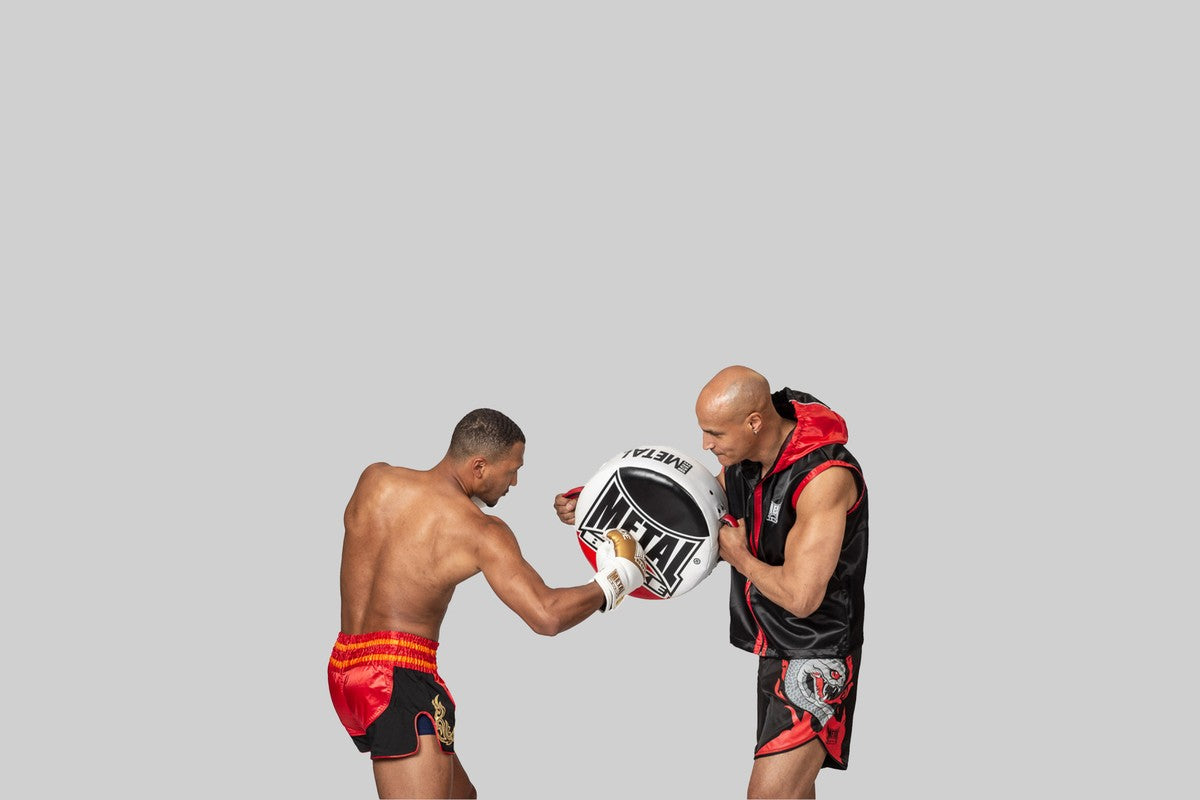
To progress alone, a heavy bag is enough to work technique as cardio; we detail the exercises in our guide of heavy bag exercises for beginners. With two, the focus mitts add the work of reflexes and precision on moving targets. And if you are still hesitating about the discipline, our guide of the different types of boxing helps to locate each style and its strikes.
At Metal Boxe, we have been designing combat sports equipment since 1999, tested in real conditions by our partner athletes. Four punches, a guard, a bag, and repetition: that is the foundation of all boxing. The rest, power and speed, comes from working them.