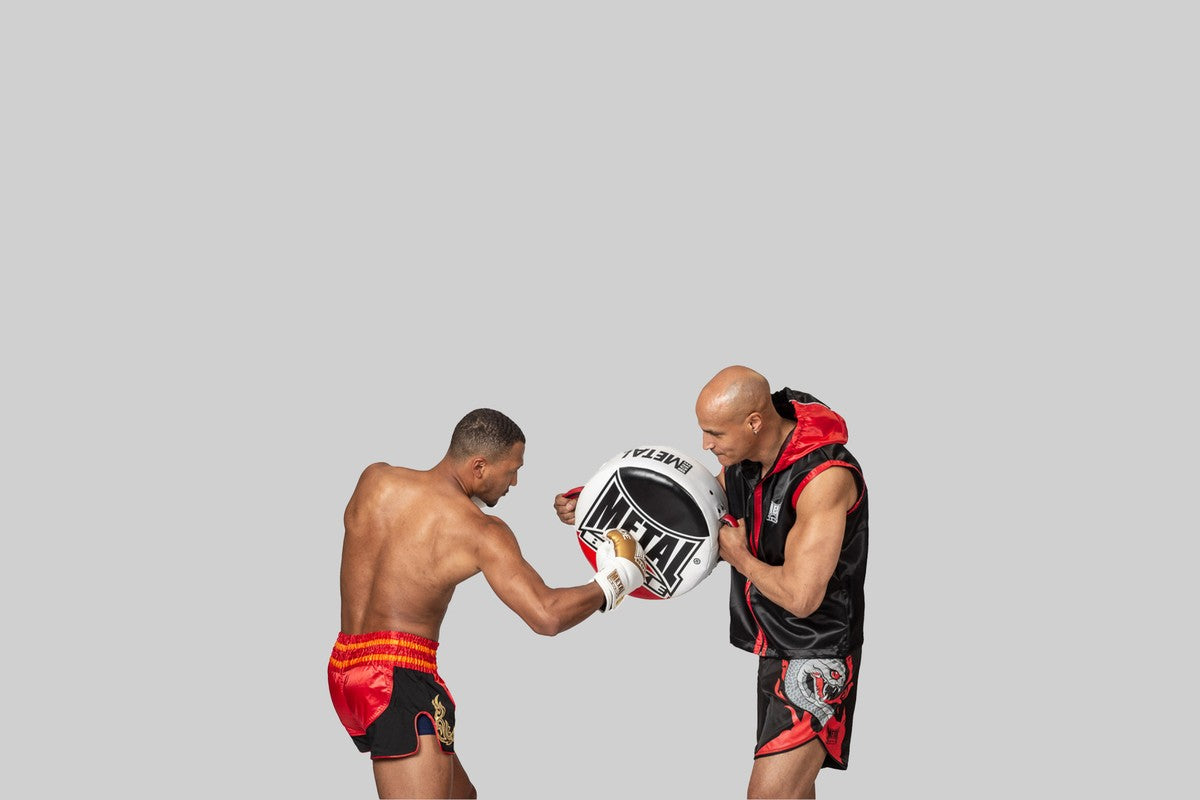

Boxing: the rules of the noble art explained
Two boxers, a square ring, gloves and a referee. Behind this simple image lies a precise set of rules, inherited from over a century of codification. Boxing is not just about exchanging blows: it defines what is allowed, how a fight unfolds, how a winner is determined and how the fighters are protected. Understanding the rules of boxing means being able to follow a fight more closely and train more effectively. This guide covers the subject in full, from the course of a match to weight categories, as well as illegal blows, the role of the judges, the knockout and the differences between amateur and professional boxing.

The basic rules of boxing
Boxing, nicknamed the noble art, pits two fighters against each other who only strike with their fists, gloved and closed. One rule structures everything else: blows are only delivered above the belt, on the front of the body and the head, never on the back or below the belt. Kicks, elbows, headbutts and throws are excluded, which distinguishes the discipline from other combat sports. Unlike French boxing, kick-boxing or muay thai, no kicks or knees are allowed, a difference that defines the entire discipline. Everything starts with a high guard, fists near the face, to which one returns after each strike.
The fight takes place in a ring surrounded by ropes, on a surface approximately six meters wide. Each boxer stays in their weight category, follows the referee's instructions and aims to score more points than the opponent, or to render them unable to continue within the limits of the rules. Fair play is part of the rules: one stops striking on the referee's order, and one never touches an opponent on the ground.
How a boxing match unfolds
A fight is divided into periods called rounds, separated by a minute of rest spent in the corner, where the coach advises and tends to the fighter. In professional boxing, each round lasts three minutes, and a match consists of four to twelve rounds depending on the level and the stakes, a world championship being fought over the maximum distance.
Between rounds, the boxer returns to their corner, marked by a color, while the other joins theirs. A gong announces the start and end of each period. Between the ropes, each manages their distance, their breath and their return to guard from one round to the next. The fight goes to its end if no boxer is stopped before: we then speak of a fight that ends at the limit, and the decision goes to the judges. If a boxer cannot continue, the confrontation stops before the planned end.

Allowed blows and illegal blows
Blows delivered with the padded part of the glove, closed fist, above the belt, on the front and sides of the head and torso are allowed. The jab, the straight punch, the hook and the uppercut all fall within this framework as long as they respect the striking zone. Touching the belt itself is already at the limit. The opponent's guard complicates the task: it must be bypassed or broken to reach the torso or head, each blow going out and coming back along the arm without ever leaving the guard open. Only the closed and gloved fist makes contact with the target, and it is the force of a well-placed punch, specific to this sport, that often decides the outcome.
Illegal blows are numerous and penalized. One does not strike below the belt, nor on the back, nor on the nape or the back of the head. Headbutts, elbow strikes, holding the opponent, pushing them, striking while the referee separates them, or continuing once the order to stop has been given are also forbidden. An infraction leads to a warning from the referee, then a point deduction in case of a repeat offense, and up to disqualification if the foul is serious or repeated.
The role of the referee and the judges in a fight
Two authorities oversee the fight. The referee, alone in the ring, ensures safety and compliance with the rules: they give instructions, separate close contact, warn or penalize in case of a foul, count when a boxer is on the ground and can stop the fight if they judge that a fighter is in danger. Their decision to interrupt is sovereign.
Around the ring, the judges, numbering three in professional boxing and often five in amateur and Olympic boxing, score each round independently. They do not communicate with each other during the fight and submit their sheets at the end. This separation of roles, safety on one side, scoring on the other, guarantees the fairness of the decision when the fight goes to its end.
The scoring system and victory on points
When no boxer is stopped, victory is decided on points. The most widespread system awards ten points to the winner of a round and nine or less to the loser, depending on the dominance. A very unbalanced round, or marked by a boxer being sent to the ground, results in a wider gap. The judges evaluate the number of clean blows landed, the mastery of the fight, defense and useful aggression. This scoring system, overseen by the major federations, also provides for the deduction of a point when the referee signals a serious foul.
At the end, the sheets are added up. If the three judges designate the same boxer, the decision is unanimous; if they are divided, it is by majority or split; and when the totals balance out, the fight is declared a draw. It is this round-by-round counting that makes boxing so tactical: each won round counts, even without a knockout.
The KO, the technical KO and the stoppage of the fight
Knocking out the opponent remains the most spectacular outcome. When a boxer touches the ground or is shaken, the referee sends them to a neutral corner and starts a count out loud. The fighter has until the count of ten to get up and show that they can continue. If they do not succeed, it is a KO, and the fight stops immediately.
There is also a protection count, often a mandatory eight-count, during which the referee observes the boxer before allowing them to continue. When a fighter remains standing but no longer defends themselves, or when their corner throws in the towel, the referee pronounces a technical KO: the fight is stopped to preserve the boxer, without a final count. This count and this precise regulation exist above all to protect the physical health of the fighter. Safety always takes precedence over the spectacle.
The different ways to win a fight
A boxing match can end in several ways, beyond the knockout alone. The clearest remains the knockout, when a boxer does not get up before the end of the count. Then comes the referee's stoppage, which ends an unbalanced fight to protect a fighter, or the surrender, when a boxer's corner throws in the towel between two rounds.
If the fight goes to its end, victory is decided by the judges' decision, unanimous, majority or split. A boxer can also win by the opponent's disqualification, in case of a serious or repeated foul, or by default if the other does not show up. In title fights, these rules are applied to the letter by the organization that awards the belt, as the stakes weigh heavily on the careers of the two men or two women in the ring.

The weight categories in boxing
To balance the fights, boxers are divided into weight categories. Each fighter is weighed before the match, and each faces an opponent of comparable size. From the lightest categories, the flyweight and super-flyweight, to the heavyweight without an upper limit, the scale counts many levels. In ascending order, we notably climb the flyweight, bantamweight, featherweight, lightweight, super-lightweight, welterweight, super-welterweight, middleweight, super-middleweight, light-heavyweight, heavyweight and heavyweight categories, each federation adjusting the thresholds. This grid serves as a reference in competition, from amateur fights to the Olympic Games as well as among professionals.
This distribution exists in both men's boxing and women's boxing, with adapted grids. It explains why the same sport produces very different styles: a lightweight relies on speed and volume, a heavyweight on the power of a single punch. Respecting their category is part of the fundamental rules, and the weigh-in conditions the holding of the fight.
Amateur and professional boxing: different rules
Two forms coexist, with very distinct regulations. Amateur boxing, that of the clubs and the Olympic Games, favors safety and technique: the fights are short, often three rounds, in assault (controlled touches) for the youngest, the wearing of a helmet was long the standard according to the categories, and the scoring rewards the precision of the touches. It is practiced in a club, under license, where each boxer progresses over the course of the lessons before competing in their first official fights. The goal is to score cleanly more than seeking the knockout.
Professional boxing extends the distance, removes the helmet and places more emphasis on power and the management of effort over many rounds. Several international organizations award their own championship belts there, each with its own code and regulations that are close but not identical. In both cases, the foundation remains the same: only fists, above the belt, under the control of a referee.

The boxer's mandatory equipment
The regulation also governs the equipment, because it protects as much as it allows fighting. Boxing gloves are mandatory, approved and adapted to the weight category, their weight being fixed according to the level and type of match. Under the gloves, the wraps hold the wrists and metacarpals. The mouthguard is mandatory, and a cup protects the lower abdomen.
In amateur boxing, the boxing helmet completes this panoply for certain categories, just like a jersey. To train to respect the striking zone and the distance, nothing replaces working on the punching bag, where one repeats the allowed blows until they become natural. Compliant equipment is the first of the safety rules.


The weigh-in, control and safety of the boxer
Even before the first blow, the regulation governs the preparation. The official weigh-in, the day before or the day of the fight, verifies that each boxer respects the limit of their category; exceeding it can cancel the match or cause the loss of the title on the scale. A medical check validates the fighter's fitness, a non-negotiable condition for getting on the ring.
During the fight, safety remains the priority of the referee and the doctor placed at the edge of the ring. A cut too deep, a groggy boxer or a count that is too long, and the match is stopped. This strict regulation, carried by the commissions and the organizations, distinguishes a supervised sport from a simple exchange of blows. In amateur as well as in professional women and men, it applies in the same way.
A history of rules, from pugilism to the Marquess of Queensberry
The current rules are the result of a long evolution. At the beginning, pugilism was practiced bare-handed, almost without a framework. The first written rules appear in the 18th century in England to limit excesses, before being specified by the London Prize Ring rules, which govern bare-knuckle fights. Champion Jack Broughton had issued as early as 1743 a first code intended to limit injuries.
The turning point comes in 1867 with the Marquess of Queensberry rules, which impose the wearing of gloves, three-minute rounds separated by a minute of rest and the famous ten-second count. Written by John Graham Chambers under the patronage of the Marquess, this code puts an end to the era of bare-knuckle pugilism, of which John L. Sullivan remains the last great champion. It is these principles that lay the foundation of modern boxing. Understanding this heritage helps to grasp why the noble art holds so much to its framework: each rule was born from a concern for fairness and the protection of the fighter.
At Metal Boxe, we have been designing combat sports equipment since 1999, tested in real conditions by our partner athletes. Knowing the rules is already boxing better: we know where to strike, when to stop and how to protect ourselves. To go further, our guide to the different types of boxing places boxing among the other disciplines, and the one on boxing blows details each allowed strike.
To practice, equip yourself with a pair of boxing gloves adapted to your level.