How to properly wrap your boxing hand wraps step by step?
Wrapping your hands is an act of preparation, a ritual before combat. Far more than just an accessory, boxing wraps protect, stabilize, and absorb. They serve to transform a fragile hand into a weapon. Boxing always begins with this detail. But to do so, you need to know how to put them on correctly. Because if they're poorly applied, they can hinder punches, compress blood circulation, or offer no absorption at all. This guide details each step, teaching you how to put on boxing wraps like a pro. Whether you're a beginner, experienced, or an Olympic boxer, it all starts with the right bandage.
What are boxing wraps for during training or a fight?
Every punch transmits a violent shockwave. This wave travels up to the joints, tendons, and wrist. Without proper wrapping, the hand can twist, shift, and get injured. Even the most high-performance boxing gloves are not enough without internal protection.
Boxing wraps help to:
- Keep joints aligned.
- Stabilize the wrist during impact.
- Distribute pressure across the entire hand.
- Absorb sweat, to preserve the gloves.
- Prevent bumps, painful creases, and unnecessary injuries.
Boxing without wraps means accepting the risk of injury every round. Regardless of whether you do Muay Thai, English boxing, or another combat sport, the reflex is the same: wrap your hands with suitable boxing wraps before stepping into the ring.
Which boxing wrap to choose based on your practice and hand size
Several lengths are available. And each format corresponds to a specific use. The choice depends on your practice, the type of training, the size of your hands, and your level of precision in wrapping.
Most commonly used lengths:
- 2.5 meters: ideal for young boxers, small hands, or quick application. Simple wrapping.
- 3.5 to 4 meters: versatile format. Allows for multiple turns, good support, suitable for most builds.
- 5 meters and more: used for high-level, professional fights, boxers with large hands, or those who want comprehensive wrapping.
Some prefer elastic wraps, while others choose rigid cotton wraps. Mexican wraps, slightly stretchy, offer a good compromise between support and comfort. It's worth testing to find out what truly suits you.
All the steps to properly put on your boxing wraps like a pro

Putting on a boxing wrap correctly is not about random turns. It's a precise method. Here's the complete step-by-step tutorial.
Step 1: Start with the thumb
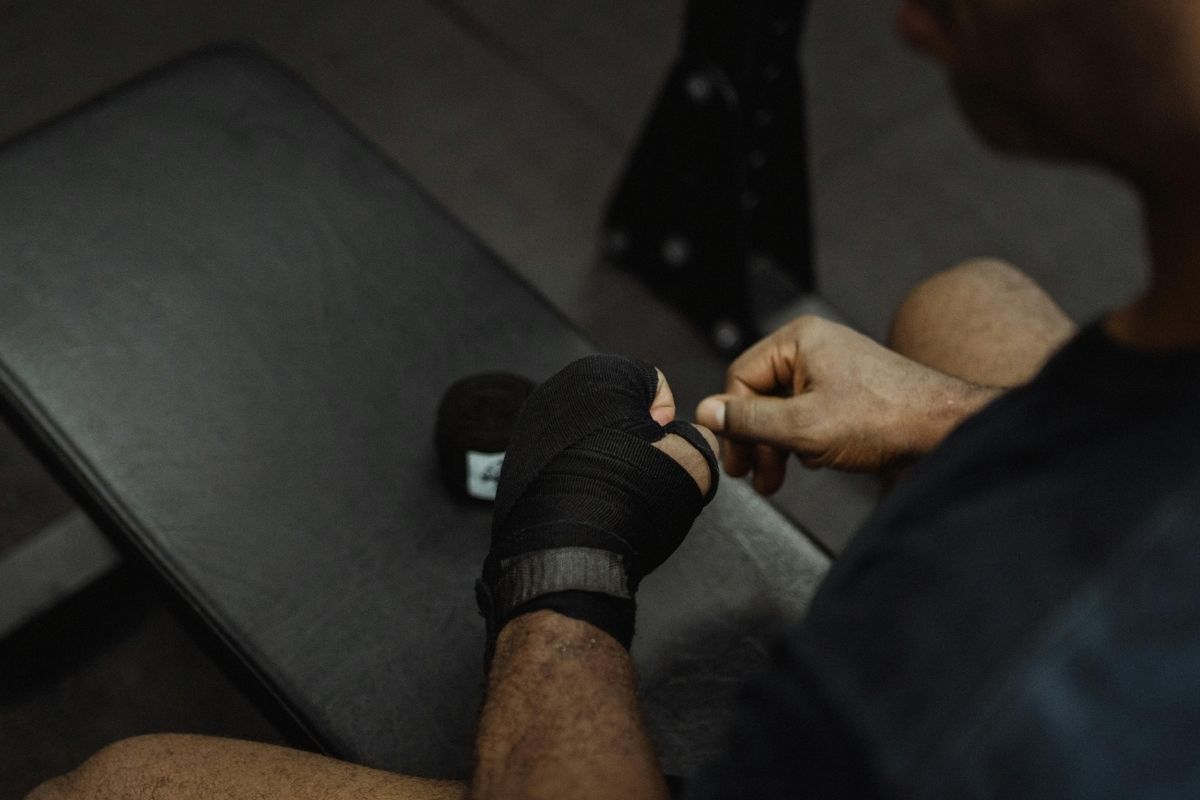
Place the wrap around your thumb, then pass it over the back of your hand. Always in the opposite direction to the natural direction of your hand. This prevents the wrap from slipping during training. Just one incorrectly oriented initial fold can make the entire wrap unstable.
Step 2: Wrap the wrist
Make three to four turns around the wrist. Not too tight. The goal is to support, not to block circulation. If you feel discomfort or your fingers swell, the tension is too strong. Conversely, too little tension negates the stabilizing effect.
Step 3: Protect the back of the hand
Then pass it over the back of the hand, from outside to inside. Then wrap the top two or three times. This part stabilizes the entire hand, distributing the pressure of impacts over a larger surface.
Step 4: Secure the fingers one by one
This is where precision makes the difference. Slip the wrap between the little finger and the ring finger, then make a full turn and go back between the ring finger and the middle finger, and finally between the middle finger and the index finger. Each space between the fingers should be crossed only once to avoid bumps or rubbing.
This passage between the fingers prevents the wrap from twisting during the fight. It stays close to the skin and does not interfere with clenching the fist.
Step 5: Reinforce the fist
Finish by making several turns around the closed fist. Generally, three to four turns are sufficient. You can alternate between the wrist and the fist to reinforce the whole. Each turn should slightly overlap, like tiles. This ensures stability and protection.
A quick method for wrapping your boxing wraps before training
For routine training, some boxers prefer a quick method. It involves skipping the passages between the fingers and limiting turns to what is strictly necessary. This is possible with good tension and suitable wraps.
This method is well-suited for shadowboxing sessions, bag work, or cardio boxing phases. However, for sparring or high-impact fights, it's better to take the time to properly wrap your hands.
Why boxing wraps protect better than gloves alone
Every poorly absorbed punch is a warning. A slightly poorly executed strike, a poorly tightened glove, an unsupported joint... And injury is guaranteed. Boxing wraps help to:
- Stabilize tendons in the long term.
- Protect fragile areas of the hand.
- Preserve gloves by retaining sweat.
- Avoid permanent dampness, which damages the inside of the glove.
They are used in all combat sports: English boxing, Muay Thai, kickboxing, Thai boxing, etc. Their use has become universal in every locker room. Even in disciplines where mitts are worn, wraps are used underneath to add a layer of protection, sometimes combined with boxing under-gloves for intensive training.
Practical tips for stable and comfortable boxing wraps
Some details change everything:
- Always stretch the wrap, but without too much pressure. You need to support without blocking.
- Slightly close your fist during wrapping. This preserves natural flexion.
- Make flat turns. No bumps, no creases. This avoids internal rubbing.
- Check the sensation: no tingling, no discomfort, good mobility.
- Test before training with a few trial punches on the bag.
With practice, wrapping your hands becomes routine. A reflex before each session. Like warming up, it's a complete phase of preparation to protect your hands before impact, just as you think about protecting your head with a boxing helmet.
The most common mistakes when putting on boxing wraps
Even among advanced boxers, some errors are common:
- Too much tension at the wrist, causing a cut-off of circulation.
- Insufficient tension on the joints, rendering the wrap useless.
- Forgetting the spaces between the fingers, which causes the wrap to slip.
- Wrapping in the wrong direction, causing the wrap to come loose during training.
- Wraps that are too short or too long, poorly suited to the hand or technique.
A bad wrap can create more problems than it solves. It hinders punching, prevents clenching the fist, and causes pain during long series. It only takes once to turn a training session into a long-term injury.
How to properly secure the end of your boxing wrap so it stays put during effort

The last step is to secure the wrap firmly so that it doesn't come undone during the round. Most modern wraps have a Velcro strap. It must be laid flat, without folding the material. For wraps without Velcro, you need to slip the end under the last loop and wedge it against the glove.
One tip is to finish on top of the wrist, to prevent the Velcro from rubbing against the inside of the glove. It's a detail, but it makes a difference in sparring.
Wrapping methods adapted to each boxer's level
There are several wrapping methods, but they all rely on the same principles: stabilize, absorb, protect.
| Level | Recommended method | Usage |
|---|---|---|
| Beginner | Simple wrist + fist wrap | Short training sessions |
| Intermediate | Wrist + fingers + fist wrap | Sparring, bag work |
| Confirmed / Pro | Full wrap (wrist + hand + finger-by-finger + fist) | Competition, high impact |
Boxing does not forgive negligence. Every joint must be protected. Putting on boxing wraps means refusing preventable injury.