
What is taekwondo?
What is Taekwondo?
Taekwondo is not just a Korean martial art. It is a complete discipline, a codified combat sport, a way to learn self-defense and self-knowledge. Born in South Korea, it developed around clear principles: technique, mastery, respect, and discipline. Today, more than 80 million practitioners in over 200 countries work on their movements, flexibility, and strength every week, on the mats of schools and clubs affiliated with local or international federations. This Olympic sport attracts with its spectacular kicks, explosive rhythm, and martial values that go beyond combat.
The history of Taekwondo and its evolution since South Korea
Taekwondo took shape in a Korea rebuilding after the Japanese occupation. In the 1940s, several masters wanted to create a modern martial art, combining traditional Korean techniques with influences from karate and kung-fu. In 1955, General Choi Hong Hi proposed a name: Taekwondo, the way of the foot and fist. The word perfectly matched what the discipline became: powerful techniques, strict training, and a martial philosophy accessible to all.
In 1973, the World Taekwondo Federation was founded. The goal: to organize, codify, and disseminate the practice worldwide. Taekwondo quickly gained popularity. Seoul 1988 marked a turning point: Taekwondo entered the Olympic Games as a demonstration sport. Twelve years later, in Sydney 2000, it became an official Olympic sport. Since then, the World Championships and international competitions have shaped a modern style, faster, more spectacular, but still linked to its Korean origins.
The philosophy and spirit of Taekwondo explained simply
Behind every kick, there is a philosophy. Taekwondo teaches that the true fight begins against oneself. Every practitioner, from the beginner with a white belt to the world champion with a black belt, works on the same core principles: self-control, respect, and discipline. These principles are practiced on the mat, but also outside of it.
The martial spirit of Taekwondo is found in every class: bowing before and after training, listening to the master's instructions, rigor in executing movements. Taekwondo is not an accumulation of techniques. It is a way, a work of precision, a search for balance between body and mind, between speed and control.
How Taekwondo is practiced and its main techniques

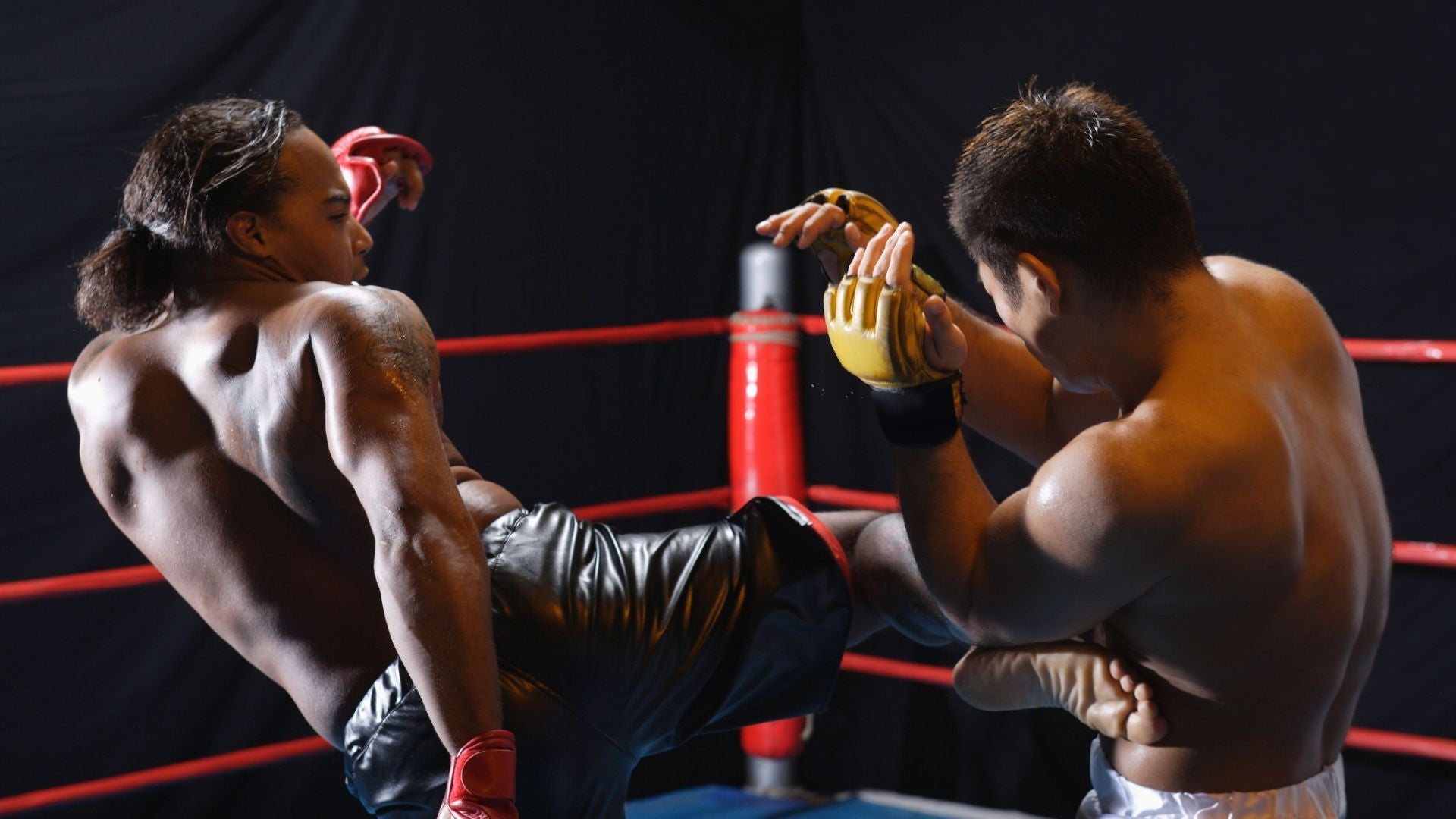
On the mat, everything starts with solid foundations. Taekwondo distinguishes itself from other martial arts by the emphasis on leg techniques. The kicks (called tchagui) are varied: dolyo tchagui (roundhouse kick), bandae dolyo tchagui (reverse kick), or ap tchagui (front kick). Each movement requires flexibility, speed, and precision.
For more stability and comfort, reinforced ankle support helps practitioners secure their footing during fast sequences and changes of direction.
Fists play a more limited role than in karate or boxing, but their use remains technical, especially for controlling distance or scoring points in competitions. In addition to sparring, technical training also includes poomsae, codified sequences that work on coordination, balance, and concentration. For self-defense, adapted techniques allow one to react to an opponent without seeking escalation, in a spirit of protection and mastery.
The belt system in Taekwondo and the meaning of each rank
The belt system is one of the symbols of Taekwondo. It reflects the progression of each practitioner. One starts with the white belt, a neutral color symbolizing the beginning. Then comes yellow, green, blue, red, and finally black, a sign of technical mastery and experience.
Each rank, called keup, marks a specific stage. Passing from one belt to another means validating techniques, demonstrating precise movements, and proving better body control. Beyond the black belt, the system evolves towards dans, which range from the first to the ninth degree. Some federations add colored stripes (blue, red, or black) to symbolize intermediate stages.
The essential uniform and equipment for practicing Taekwondo
On the mat, the dobok is the mandatory uniform. Lightweight and loose, it allows for fast movements and great freedom in executing techniques. The collar of the dobok varies according to the level: white for beginners, black for black belts.
In competition, safety comes first. Protections are comprehensive: chest protector, arm guards, shin guards, helmet, mouthguard, groin guard. This equipment ensures intense but controlled fights, where the power of the blows remains managed. Authorized zones are codified: the torso, face, sometimes the head, according to current rules.
Why kihap, the Taekwondo shout, is essential during training and combat
The shout, called kihap, is part of Taekwondo's martial identity. With each powerful movement, the practitioner releases a strong sound. This is not just a shout: it is a tool. It serves to release energy, strengthen concentration, surprise the opponent, and link breath to movement.
In competitions, kihap often accompanies decisive techniques, reinforcing psychological impact. In training, it sets the rhythm of sequences and reminds that each blow must be executed with intention and control.
Taekwondo or Karate: understanding the differences between these martial arts
Taekwondo and Karate share martial roots, but their styles are different. Taekwondo, of Korean origin, emphasizes fast and spectacular kicks, with a constant focus on speed and flexibility. Karate, from Japan, offers balanced techniques between fists and legs, with low stances and a search for direct impact.
In competition, Olympic Taekwondo prioritizes leg work, with targeted strikes to the torso and face, while punching serves more to manage distance than to score points. Karate, on the other hand, adapts its rules according to styles: some federations limit the power of strikes, others allow for more direct contact.
The benefits of Taekwondo on body and mind
Taekwondo offers physical and mental benefits that make it one of the most complete martial arts. Physically, the sessions engage the entire body. The kicks improve flexibility and coordination, fast sequences develop endurance, and the intensity of fights strengthens muscle power. Working on technical movements requires great precision, which also refines balance and reaction speed.
Mentally, Taekwondo develops self-control, concentration, and perseverance. Each class, each belt to pass requires total commitment. The values instilled during training (respect, humility, discipline) apply in daily life. It is this mix of physical demands and mental stability that attracts so many adults and children to this martial discipline.
Taekwondo for children and adults: a discipline adapted to all ages

Taekwondo adapts to everyone. For children, from 4 or 5 years old, practice begins with basic movements. They learn to control their body, to move, to work on coordination, and to understand the rules of the dojo. The playful aspect remains present, but technical demands are quickly introduced, with exercises designed for step-by-step progression.
For adults, practice offers a perfect balance between physical development and technical mastery. Some train for pleasure, others for the sporting challenge, and many for self-defense. Classes often welcome practitioners of all levels. Beginners train alongside black belts. This cohabitation creates a motivating atmosphere, where everyone progresses at their own pace, without losing sight of the demanding progression that characterizes this discipline.
Taekwondo and its journey to Olympic sport status
Since its entry into the Olympic Games in Sydney in 2000, Taekwondo has established itself as a modern combat sport. Olympic competitions attract the best Taekwondo practitioners from around the world, each seeking to dominate the combat area.
The Olympic format imposes strict protections: electronic chest protector, helmet, arm guards, shin guards, and mouthguard. Points are awarded according to precise criteria. A well-executed kick to the torso scores points. A controlled and fast kick to the face scores more. Speed and precision make the difference, as much as the ability to manage the rhythm of the rounds. Champions like Hadi Saei, Jade Jones, and Steven Lopez have made history by becoming Olympic champions, inspiring a whole generation of practitioners.
Taekwondo competitions and championships around the world
The world of Taekwondo lives to the rhythm of competitions. The World Championships, organized by the World Taekwondo Federation, bring together the best fighters from all countries. These events showcase very high-level fights, where technical mastery, speed, and tactics are pushed to the extreme.
Alongside international competitions, there are continental championships, national tournaments, and local competitions. Each level allows one to assess progress, test techniques in real situations, and gain experience. The central referee ensures respect for the rules and the safety of each practitioner, reminding that discipline remains at the heart of combat.
The differences between ITF Taekwondo and Olympic Taekwondo (WT)
There are two major schools in Taekwondo: the ITF (International Taekwon-Do Federation), founded by General Choi Hong Hi, and the WT (World Taekwondo) version, recognized by the International Olympic Committee.
ITF Taekwondo maintains a traditional approach, focusing on technical work, self-defense, and precise sequences. Combat remains controlled, with less impact and more strategy.
WT Taekwondo, more athletic, has adapted to international competitions. The rhythm is faster, exchanges are explosive, and spectacular kicks are favored. This version has popularized Taekwondo worldwide, while retaining the martial spirit that defines this discipline.
The principles and values that make Taekwondo more than a combat sport
Taekwondo is based on clear principles, taught from the first lesson:
- Courtesy: respect for masters, partners, and every opponent.
- Integrity: remaining fair, whether in training or competition.
- Perseverance: moving forward, even when progress seems slow.
- Self-control: controlling one's reactions, both on the mat and in life.
- Indomitable spirit: never giving up in the face of difficulty.
These values give Taekwondo a dimension that goes beyond a simple combat sport. Every practitioner, whether aiming for a black belt, a place in competition, or simply better physical condition, integrates these principles into their daily practice.
How Taekwondo became a globally popular sport
Taekwondo has established itself as a global sport. The World Taekwondo Federation claims more than 80 million members in over 200 countries. Schools are opening everywhere, from local level to high-level academies. This success is due to a progressive practice, accessible to beginners as well as high-level competitors, and a modern format that combines tradition and spectacle.
The discipline today coexists between two different approaches: one traditional, focused on martial philosophy and technical mastery, and the other, more athletic, oriented towards competitions and the explosiveness of exchanges. This ability to evolve without losing its identity makes Taekwondo a reference in the world of martial arts.
The technical and physical aspects that make Taekwondo rich
Practicing Taekwondo means working the body as a whole. Kicking techniques require flexibility, speed, and a keen sense of balance. Each movement is built on precise foundations, from foot positioning to hip rotation, all the way to the perfect placement of the fist or the ball of the foot on the target.
Physical work is intense. High-level fighters train several hours a day to perfect their techniques and maintain impeccable physical condition. This blend of strength, endurance, and coordination forges complete athletes, capable of performing rounds with the same precision and speed from start to finish.